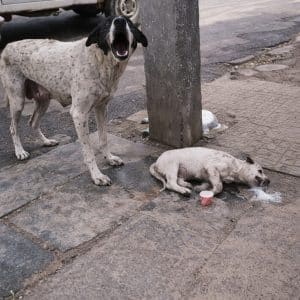
Atrey’s life began in quiet suffering, hidden from most of the world. For a long time, his days followed the same painful routine. He was chained to a post, confined to a small space that allowed little movement and no freedom. The chain limited not only his body, but his entire experience of the world. He watched life pass by from the same spot, day after day, season after season.
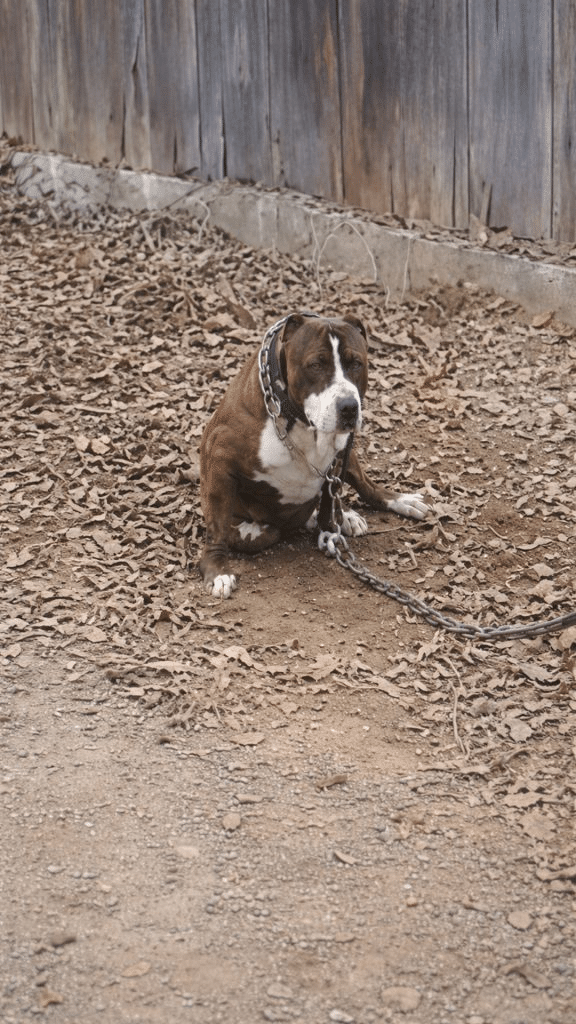
Occasionally, a few kind-hearted people noticed him and left food nearby. Those small gestures helped him survive, but they could not replace what he truly needed—care, safety, and the ability to move. Most of the time, Atrey was alone. His muscles weakened from lack of use, and his body adapted to stillness rather than movement. Yet even in isolation, something inside him remained intact. His spirit did not fade. He endured.
When rescuers finally came for Atrey, the reality of his condition was immediately clear. Years of restriction had taken a heavy toll. His hind legs were underdeveloped and weak, shaped by long periods without proper movement. As he was freed from the chain, it became evident that his struggle went deeper than muscle loss. Medical examinations soon revealed a spinal compression tumor, a condition that explained the pain he had been living with for so long. To make matters worse, he was also battling a lung infection that threatened his overall health.
Despite everything, Atrey greeted people with warmth. He wagged his tail. He showed interest in toys. Even while in pain, he responded with affection and curiosity. That contrast—between his physical suffering and his gentle, playful nature—left a deep impression on everyone who met him. It was clear that Atrey was not broken. He was waiting.
Rescue did not mean instant relief. It marked the beginning of a difficult and uncertain journey. His caregivers knew that without intervention, his condition would only worsen. Surgery became unavoidable. The tumor pressing against his spine had to be removed if he was ever going to have a chance at comfort and mobility. But before surgery could take place, Atrey needed time—time to stabilize, to build strength, and to prepare emotionally and physically for what lay ahead.
Through it all, Atrey remained remarkably calm. He accepted care with trust. He leaned into gentle touches. Even on difficult days, his resilience never disappeared. He faced the unknown with quiet courage, surrounded by people who believed he deserved more than survival.
Video Atrey’s Remarkable Journey: Overcoming Adversity and Fighting for Mobility
The surgery was a defining moment. The procedure was complex, and the outcome uncertain. When it was finally complete, everyone waited anxiously for the results. Then came the news that changed everything—the tumor was benign. Relief spread through the room. For the first time, Atrey’s future felt open again.
Recovery began slowly. The days following surgery were focused on healing and comfort. Gentle movements replaced complete stillness. Rehabilitation became part of his daily routine. Atrey was introduced to supportive exercises designed to help him relearn balance and strength. A wheelchair provided him with mobility, allowing him to explore his surroundings without pain while his body healed.
Just twelve days after surgery, his stitches were removed. Even then, progress was already visible. Small improvements appeared where none had existed before. Atrey began to support some of his own weight. He shifted his posture. He showed determination in every attempt to move forward, no matter how small the step.
As weeks turned into months, his recovery continued. Around nine months after surgery, hydrotherapy was introduced to help rebuild the muscles along his back and hind legs. The water supported his body while encouraging movement, allowing him to strengthen without strain. The process was slow, requiring patience from everyone involved—but Atrey never stopped trying.
There were days when progress felt minimal. Days when the wheelchair was still necessary. Days when rest mattered more than movement. But Atrey’s attitude never changed. He remained engaged, alert, and eager to participate in his own recovery. His resilience became his defining trait.
Today, Atrey’s journey is still unfolding. He continues to rely on his wheelchair at times, but his strength has improved significantly. His caregivers remain hopeful that one day, he will walk independently. Whether that day comes or not, Atrey has already achieved something extraordinary. He has moved from confinement to possibility, from pain to care, from neglect to belonging.
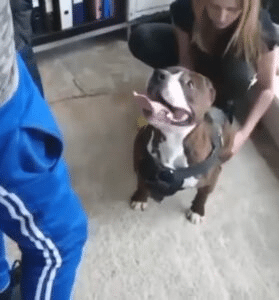
Atrey’s story is not only about medical recovery. It is about what happens when compassion meets perseverance. Every milestone he has reached is the result of consistent care, patient rehabilitation, and people who refused to give up on him. His progress reminds us that healing is rarely instant, but it is always meaningful.
More than anything, Atrey represents the power of second chances. His life could have remained limited by chains and silence. Instead, it was rewritten by empathy and action. Through love, medical care, and unwavering support, he was given the opportunity to experience dignity, comfort, and hope.
Atrey continues to grow stronger each day. His future is no longer defined by what he endured, but by what he is becoming. His story stands as a reminder that even the longest periods of suffering can give way to healing—and that every animal, no matter how difficult the past, deserves the chance to move forward.