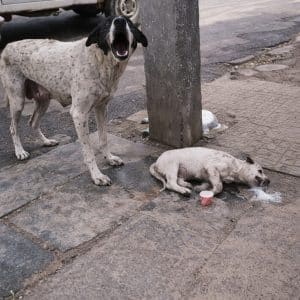
Found Where No Puppy Should Ever Be
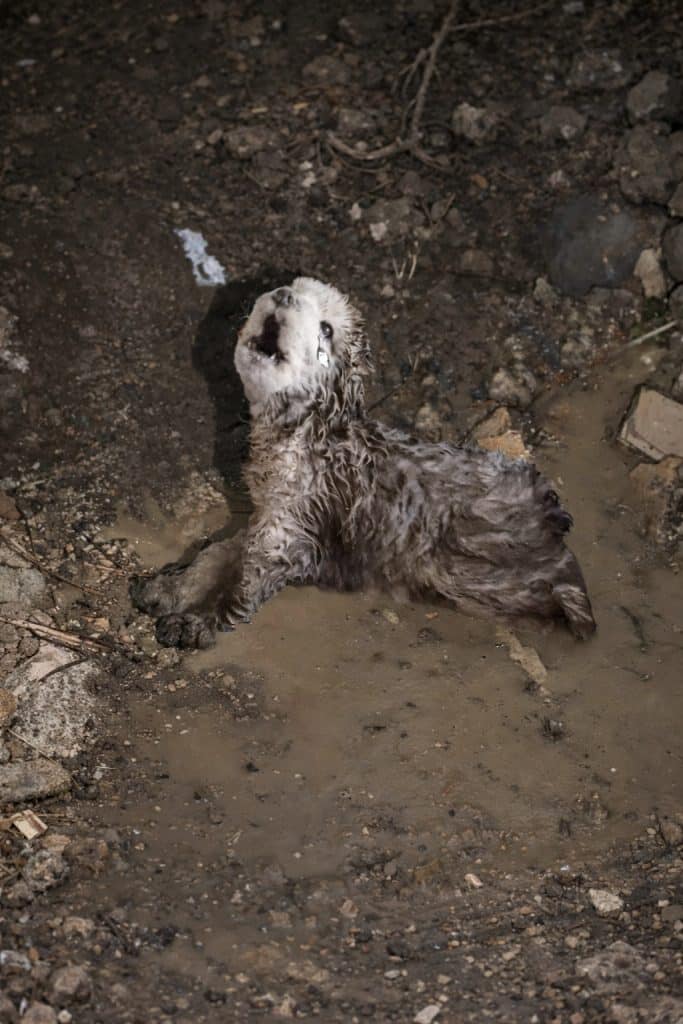
Juno’s life began not in warmth, but in pain.
He was found by a group of children lying in a muddy puddle along a city street. His tiny body trembled uncontrollably. He was barely more than a puppy — fragile, confused, and already carrying wounds far too heavy for his age.
One of his legs was broken.
His pelvis was crushed.
His small frame shook from shock and exhaustion.
And then there was the quiet evidence of cruelty.
His ears and tail had been cut off only days before.
By the time he was rushed to a local clinic, Juno was hovering between survival and surrender. He did not cry loudly. He did not struggle.
He simply endured.
A Diagnosis That Felt Final
To understand the full extent of his injuries, Juno was transferred to Moscow for advanced evaluation. The medical findings were devastating.
He had suffered a compression fracture of the spine.
There were severe neurological complications.
He was missing a cervical vertebra.
The conclusion was heavy and direct: permanent paralysis was likely. Surgery was not an option. Walking again was considered impossible.
For a puppy who should have been learning to run and play, the future seemed confined to a metal crate and a life of limited movement.
Pain management became the focus. He required regular cleaning and constant monitoring. Days passed slowly inside the enclosure where he lay, unable to move his back legs.
Yet something about Juno felt different.
He watched.
He responded.
He stayed present.
And that quiet awareness gave his caregivers a reason to try.
Video: Told He Would Never Walk Again, This Tiny Puppy Refused to Give Up
When Persistence Became His Lifeline
The team refused to accept that paralysis would be the final word.
Even when hope seemed fragile, they began gentle rehabilitation.
Soft massage therapy.
Low-level laser treatments.
Carefully guided movement exercises.
There was no dramatic change at first. Only small routines repeated daily, built on patience rather than expectation.
Then, on day eight, something happened.
Juno moved two tiny toes on his back paw.
It was barely noticeable. But for those watching closely, it felt monumental.
On day twelve, another breakthrough arrived.
He was able to relieve himself without assistance — a major sign that nerve signals were beginning to reconnect.
Hope, once faint, grew steadier.
By day nineteen, Juno began hydrotherapy sessions. In the water, his body felt lighter. His muscles, protected from strain, could move more freely. Swimming helped prevent further atrophy and gave him something equally important — momentum.
His body had been told it could not recover.
But it was listening to a different message.
Strength Beyond His Size
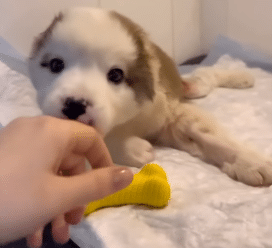
Recovery was not smooth or easy.
His back legs developed stiffness and contraction, sometimes feeling rigid and unresponsive. Progress was inconsistent. There were setbacks.
Yet Juno never seemed discouraged.
He greeted caregivers with enthusiasm.
He wagged what remained of his tail.
He leaned into affection.
He did not understand the label “special needs.”
He only understood connection.
Slowly, he learned to balance on three legs. He practiced shifting weight forward. He pushed himself, not with frustration, but with determination that seemed instinctive.
To everyone around him, Juno became more than a patient.
He became proof.
Proof that resilience can exist even in a body that has been deeply harmed.
The Letter That Changed Everything
Then came the moment that reshaped his future.
A woman named Yulia reached out after hearing Juno’s story. She didn’t ask whether he would ever be “normal.” She didn’t hesitate over medical complications.
She simply said she wanted to give him a home.
Not a temporary foster.
Not a waiting space.
A home.
Leaving behind the cold metal enclosure was more than a physical change for Juno. It was a shift in identity. He was no longer a case study or a long-term patient.
He was someone’s dog.
He belonged.
Day 200 — Running in a Way That Was His Own
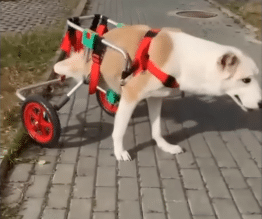
Nearly two hundred days into his journey, Juno received a custom wheelchair designed to support his back legs.
The first time he was fitted into it, there was uncertainty.
Would he understand?
Would he resist?
Instead, he moved forward.
At first cautiously.
Then faster.
Then with unmistakable joy.
The wheelchair did not limit him.
It liberated him.
For the first time, Juno could run across open ground. He could chase. He could explore. He could keep up with other dogs.
The image that followed became unforgettable.
Juno, dressed in a festive reindeer sweater during winter, racing across snow-covered ground, playing freely alongside his canine companions.
No hesitation.
No sadness.
No trace of the mud where he had once lain broken.
Only movement.
Only life.
What Juno’s Story Leaves Behind
Juno’s past cannot be erased.
But it no longer defines him.
He was once a trembling puppy in a puddle, carrying injuries that seemed impossible to overcome. He was told he would never walk again.
Today, he runs in his own way.
He plays in his own way.
He lives fully — in his own way.
His story is not about cruelty.
It is about what happens when cruelty is met with relentless compassion.
It is about doctors who refused to stop trying.
About rehabilitation built on patience.
About a woman who saw beyond disability and chose love.
And most of all, it is about a small puppy who never accepted that “impossible” was the end of his story.