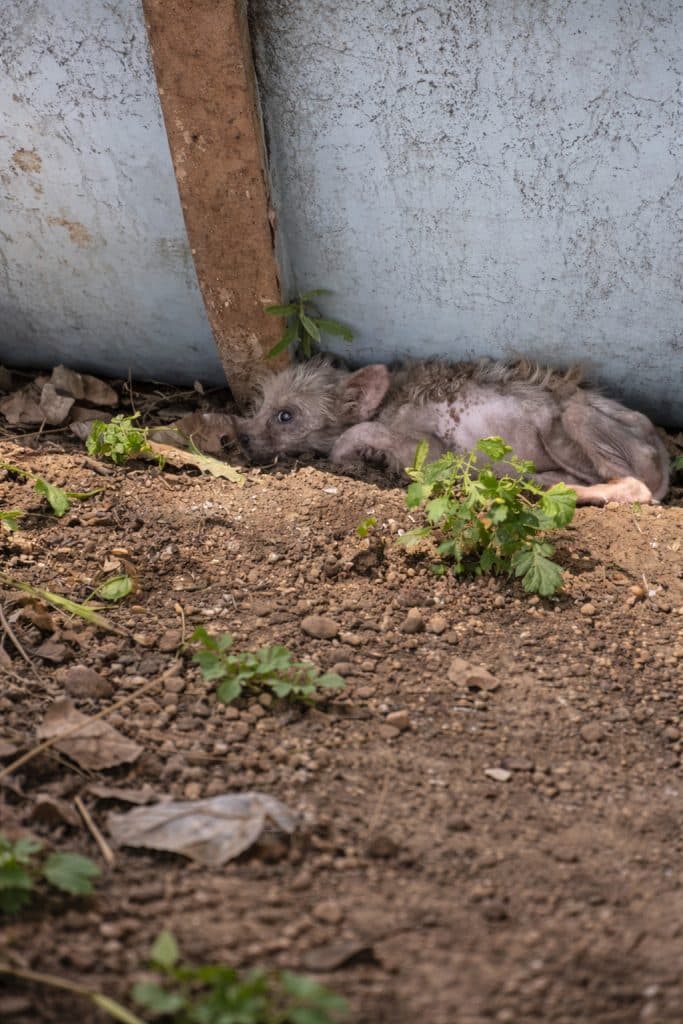
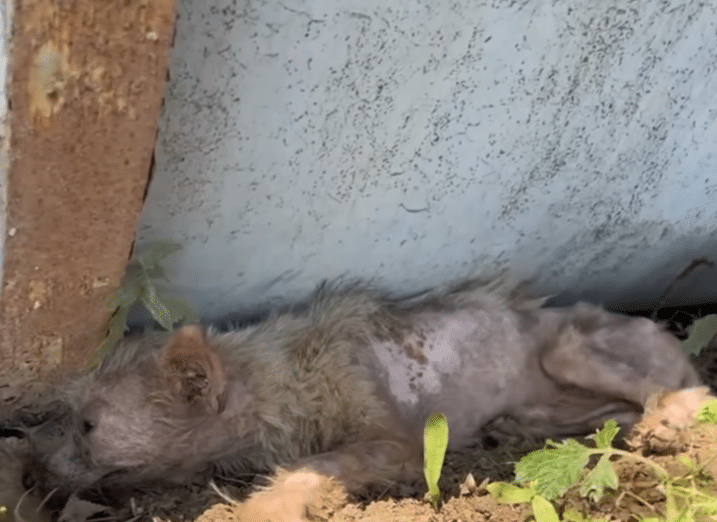
In Miryang, in South Korea’s Gyeongnam province, a small dog lay on flattened cardboard sheets.
He could not stand.
His back legs were stiff and straight, muscles wasted from disuse. To move, he pulled himself forward with his front paws, dragging the rest of his body behind him.
His name was Sunsimi.
And for a long time, he had been alone.
He once belonged to an elderly woman who loved him. But when she was hospitalized for long-term treatment and could not return home, Sunsimi was left behind — still tethered by a heavy iron chain that pressed deeply into his neck.
There was no one to remove it.
No one to lift him.
No one to notice when he stopped being able to walk.
Locals suspected he had been hit by a car at some point. Without medical care, his spinal and pelvic injuries healed improperly. His hind legs grew thinner, weaker, eventually frozen in place.
Yet he survived.
The Woman Who Refused to Give Up on Him
Yoon Hee-soon discovered Sunsimi while volunteering to care for elderly residents in the area.
Many believed the small dog had no chance. Some suggested euthanasia, saying his condition was too severe.
But she saw something different.
She saw life in his eyes.
Despite his pain, Sunsimi wagged his tail when she approached. He ate eagerly. He greeted her with quiet joy.
He wanted to live.
So she chose to fight for him.
She brought him into her care and began searching for specialized treatment, determined to give him every chance possible.
Video: Paralyzed and Chained — Sunsimi’s Brave Fight for a Second Chance
At a veterinary hospital in Seoul, specialists examined Sunsimi thoroughly.
The findings were complex and alarming.
He had a fractured pelvis and serious spinal injury — the reason he could not walk.
But there was something even more dangerous.
Sunsimi tested positive for advanced heartworm infection.
The parasites had accumulated heavily within his pulmonary arteries and heart. His heart was enlarged. Circulation was compromised. His body was functioning under immense strain.
Suddenly, his case became far more delicate.
A Life Balanced Between Risk and Hope
To walk again, Sunsimi would eventually need pelvic surgery.
But anesthesia in his current state could be fatal. With severe heartworm burden, the risk of cardiac arrest during surgery was extremely high.
The veterinary team made a difficult decision.
First, they would stabilize his heart.
Treatment for heartworm began immediately. Medication was administered carefully to reduce the parasite load while monitoring for complications. After two weeks of medical management, Sunsimi was scheduled for surgical heartworm removal — a procedure itself filled with risk.
His guardian, Ms. Hee-soon, remained by his side.
So did her sister.
They spoke softly to him.
They prayed.
They hoped.
Sunsimi did not shrink from the hospital environment.
He walked — or rather dragged himself — forward into the clinic doors each time, trusting the hands guiding him.
Courage on the Operating Table
The day of surgery arrived.
The room was quiet.
The stakes were high.
Sunsimi’s heart condition made even routine procedures dangerous. But without intervention, his condition would only worsen.
As he was carried into the operating room, there was no resistance in his body — only calm.
The video ends not with certainty, but with hope.
A small dog who once lay chained and forgotten now stood at the threshold of possibility.
What Sunsimi’s Story Teaches Us

Sunsimi’s journey is not just about medicine.
It is about choice.
An elderly woman’s absence left him vulnerable.
An accident left him paralyzed.
A heavy chain left marks around his neck.
But one person chose differently.
She chose compassion over convenience.
Treatment over surrender.
Hope over resignation.
Sunsimi may still face surgeries and rehabilitation.
He may still carry scars.
But he is no longer invisible.
His story reminds us that even when a body is broken and a heart is burdened, love can become the steady force that carries someone forward.
Because sometimes, miracles do not begin in operating rooms.
They begin the moment someone says:
“I won’t leave you behind.”