Alone in an Industrial Wasteland
The setting was bleak.
An abandoned industrial yard filled with shipping containers, scrap materials, and scattered construction debris. No homes. No warmth. No sign that life belonged there.
And yet, moving cautiously between rusted metal and stacked pallets, there was a large white dog.
His name would later become Tonka.
He was painfully thin. His coat looked rough and unkempt. The bridge of his nose was scraped and reddened — likely from repeated attempts to squeeze through barriers or search desperately for food.
He walked slowly.
Stopping often.
Scanning constantly.
Hunger pulled him forward.
Fear held him back.
A Rescue Built on Patience
One rescuer made a decision that would shape everything that followed.
Instead of chasing him, he sat down.
On the cold ground.
For hours.
He lowered his posture to appear less threatening and gently placed pieces of food along a path leading toward a humane trap. He avoided sudden movements. He avoided eye contact that might feel confrontational.
Tonka noticed.
He crept closer.
Sniffed the food.
Took a piece.
Stepped forward.
Then froze.
His body trembled with internal conflict — the need to eat battling the instinct to survive.
He stepped inside the trap briefly.
Then backed out again.
Trust was not something he could give easily.
Video: Terrified Industrial Yard Dog Finally Gets Rescued — Tonka’s Emotional Capture
When the Plan Changed
Suddenly, something shifted.
Tonka became alert.
Whether he sensed the trap or was startled by a noise, he bolted away from the setup.
The rescue team knew time was limited.
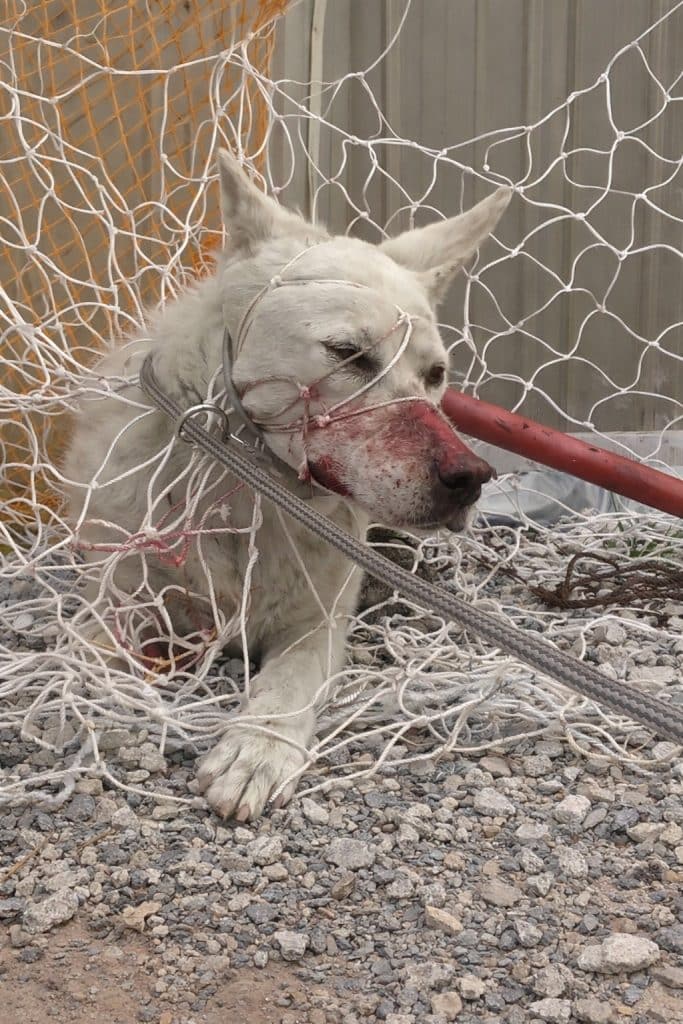
They carefully adjusted their approach and prepared a humane net capture — a last-resort method used only when patience alone cannot secure safety.
When the net closed around him, panic erupted.
Tonka thrashed and growled, his body fighting desperately against what he perceived as danger. He tried to bite through the netting. In the struggle, his nose began to bleed slightly, either reopening an old wound or from friction against the mesh.
It was heartbreaking to watch.
But the rescuers did not react with force.
They reacted with calm.
Loreta, one of the rescuers, spoke softly to him. Her voice remained steady and reassuring as she gently touched him through the net, trying to slow his breathing and ease his fear.
Gradually, the resistance softened.
The fight drained into exhaustion.
Arrival at CARES
Tonka was safely secured in a crate and transported to the CARES rescue center.
There, the industrial yard was replaced with shelter walls and clean space.
But fear does not disappear at the door.
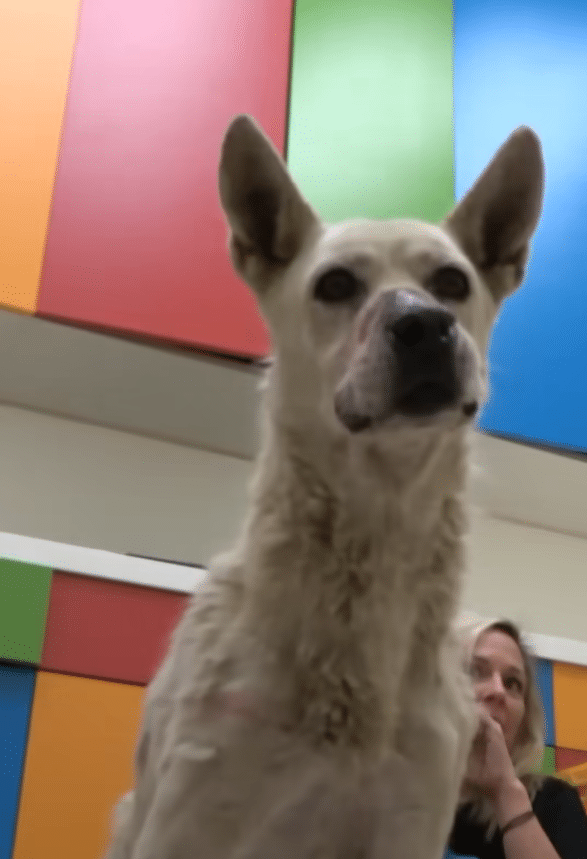
Tonka sat rigid inside his kennel. Overwhelmed. Watching every movement closely. When a rescuer extended a hand slowly for him to sniff, he hesitated. At times, he would pull back sharply. Once or twice, he made small defensive gestures — not out of aggression, but out of confusion and trauma.
He did not yet understand that he was safe.
But he was.
And that mattered.
An Open Beginning
The video closes not with a dramatic transformation, but with something quieter.
Tonka sits inside his enclosure at CARES, alert but no longer running. His eyes still carry uncertainty, but they are no longer scanning an empty industrial yard.
He is fed.
He is sheltered.
He is protected.
The organization Hope For Paws encourages viewers to follow Tonka’s continued recovery on their website, where updates will show the gradual process of healing — not only physically, but emotionally.
Because for dogs like Tonka, rescue is not a single moment.
It is a series of patient steps.
The first one has already been taken.