A Dark Figure in Rushing Water
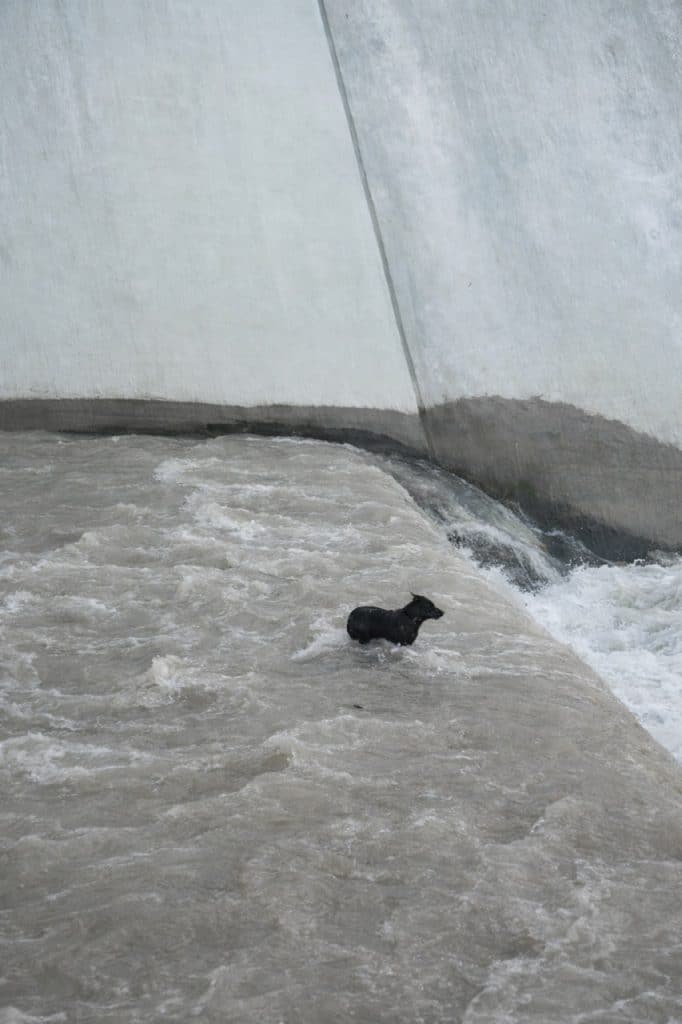
It happened along a wide canal in Almaty, Kazakhstan.
The water was moving fast — cold, relentless, pushing everything in its path forward. Along the steep concrete walls, there was no easy escape.
In the middle of that current stood a black dog.
He wasn’t swimming freely.
He wasn’t safe.
He was trapped.
The slope of the canal wall was too high, too slick to climb. The current pressed against his legs, threatening to pull him deeper. He stood as still as he could, fighting not to lose his footing.
Each passing second brought him closer to being carried away.
And then someone saw him.
One Man Steps Into the Current
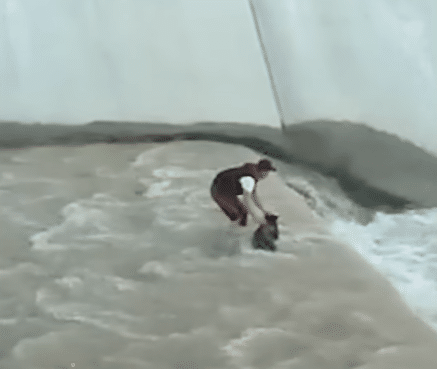
Without hesitation, a man climbed down into the canal.
The water rushed around his legs as he made his way carefully toward the stranded dog. He moved slowly, aware that one wrong step could send them both sliding.
When he reached the dog, he held him firmly but gently.
The dog did not struggle.
He didn’t panic.
He simply stood there, trusting the stranger who had entered the water for him.
But the problem remained.
The concrete wall was too high.
Too steep.
Too long.
The man could hold the dog — but he couldn’t climb out alone.
When Strangers Choose to Act
What happened next was something no one planned.
People passing by stopped.
They saw the man in the water. They saw the trapped dog. And instead of watching from a distance, they began to move.
One by one, strangers climbed over the protective railing. They reached for each other’s hands, forming a human chain that stretched from the top of the canal wall down toward the water below.
Arms extended.
Fingers locked tightly.
Feet braced against the incline.
They weren’t friends.
They weren’t family.
They were simply people who decided not to walk away.
Video: Strangers Formed a Human Chain to Save a Dog From Rushing Waters in Kazakhstan
Holding On When It Wasn’t Enough
Even with the human chain in place, the distance was still too great.
The slope was longer than expected. The lowest person in the chain still couldn’t quite reach the rescuer below. The water continued to surge around the man and the dog.
Time felt heavier.
But no one let go.
The man in the water held the dog steady. The dog remained calm, pressed close, as if understanding that movement could make things worse.
Above them, the group held their positions, muscles straining, waiting for something — anything — that might close the final gap.
Then another man ran toward the scene.
Without hesitation, he joined the chain.
That single addition made all the difference.
The Moment the Chain Reached Far Enough
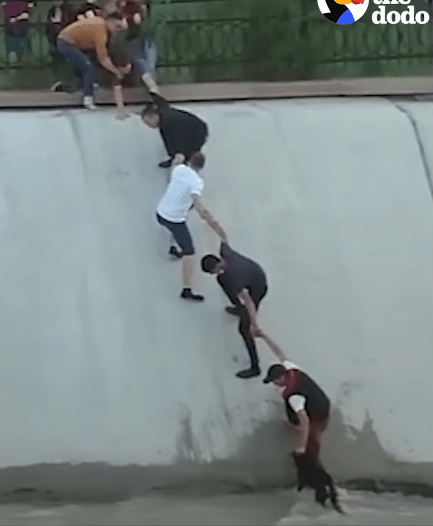
With the extra reach, the lowest helper finally grasped the rescuer’s arm.
A solid hold.
From there, it became a collective effort.
The people at the top leaned back carefully, anchoring themselves. Those in the middle tightened their grips. Together, they pulled — slowly, steadily, carefully — lifting both the man and the dog up the slippery concrete slope.
Shoes scraped.
Hands strained.
Voices called out encouragement.
And then — they reached the top.
The dog was passed safely over the railing.
The rescuer followed.
Relief rippled through the group like a shared breath finally released.
A Reminder of What We’re Capable Of
There were no uniforms.
No official rescue teams.
No rehearsed plan.
Just ordinary people responding to an urgent need.
The black dog who stood moments away from being swept away was now safe on solid ground. His body shook — not from cold alone, but from the intensity of what had just happened.
But he was alive.
Because one man stepped into the water.
Because strangers reached for one another.
Because no one chose to turn away.
In a world that often moves quickly past quiet emergencies, this moment stands as proof:
Compassion can travel hand to hand.
Courage can be shared.
And sometimes, it takes a chain of strangers to carry one small life back to safety.