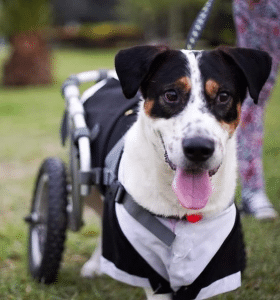
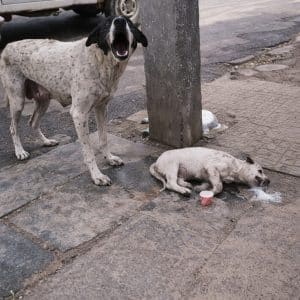
Left Behind in a Place Full of People
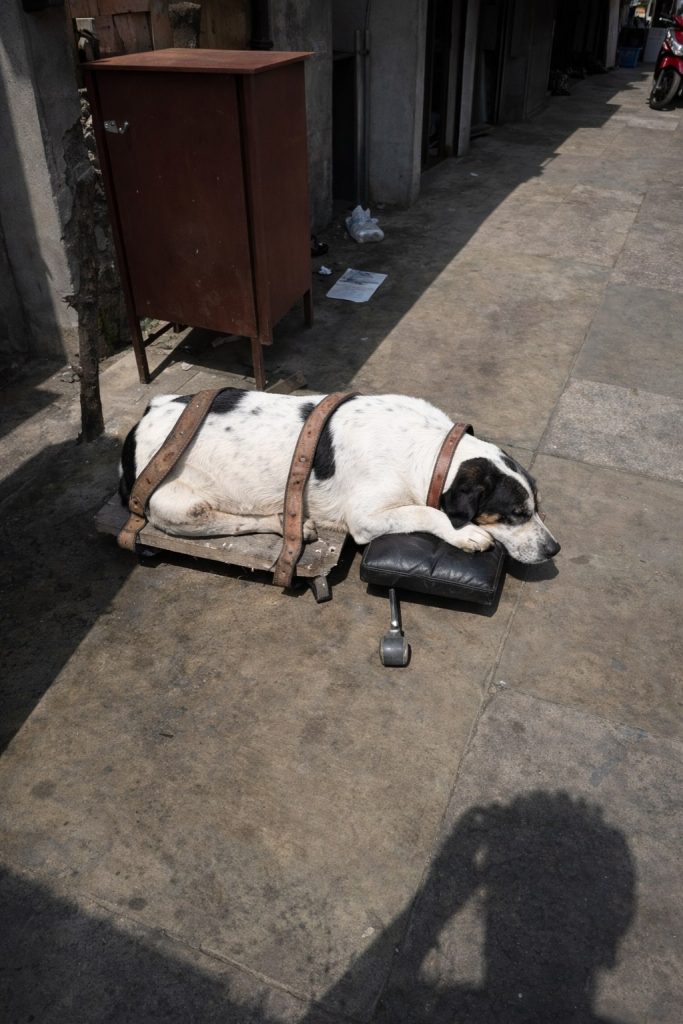
In the middle of a crowded train station in Lima, Peru, where announcements echoed and commuters hurried past, a small dog sat perfectly still. He was tied tightly to a piece of wheeled equipment, left behind as if he no longer mattered. People walked by for hours, eyes fixed on schedules and destinations, unaware that a life was quietly slipping away right in front of them.
The dog’s body had gone rigid from exhaustion. Thick straps pressed into his frame, holding him so tightly that even a small shift was impossible. His head drooped forward, too heavy for his weakened neck to lift. He didn’t bark or cry. He didn’t struggle. He waited in silence, conserving the last of his strength, as if he had already learned that noise no longer brought help.
Later, he would be called Cabezón—a name inspired by the way his head fell forward from injury and fatigue. But in that moment, he was simply another forgotten dog in a city where strays are often overlooked. Surrounded by constant movement, he remained unseen.
It wasn’t the rushing adults who finally noticed him. It was a group of children who stopped, drawn by something others had missed. They saw his labored breathing, the fear in his eyes, the way his body trembled when he tried to move. They brought him food and water and stayed close, offering comfort simply by being there.
VIDEO: Tied, Injured, and Forgotten — This Dog Was Left at a Train Station Until One Woman Stepped In
With patience, the children managed to loosen the straps and free him. But once untied, the truth became painfully clear. His body wouldn’t respond. He couldn’t stand. He couldn’t support himself. The exhaustion gave way to confusion, revealing injuries far more serious than anyone had expected.
Word of the dog reached Sara Moran, founder of the rescue sanctuary Milagros Perrunos, known for helping dogs with severe disabilities. When Cabezón arrived, veterinarians confirmed devastating damage: spinal trauma, kidney failure, untreated wounds, and internal injuries caused by being restrained for too long. He had been forced to remain immobile, unable to relieve himself, unable to escape constant pain. He would never walk again.
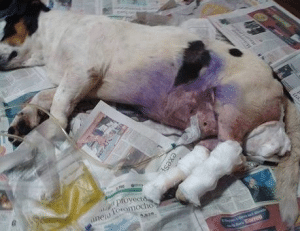
For many dogs, that diagnosis would have meant the end. But at Milagros Perrunos, hopeless cases are exactly the ones they fight for. Cabezón was given clean bandages, a soft bed, and something he hadn’t known in a long time—gentle human touch. Volunteers stayed by his side, repositioning him carefully, managing his pain, and speaking softly so he never felt alone.
Recovery was slow and uncertain. Some days were harder than others. But even in his weakest moments, Cabezón responded to kindness. He lifted his eyes when someone approached. His body relaxed under a gentle hand. Small signs, but powerful ones.
Today, Cabezón’s future remains uncertain. His medical needs are complex, and his mobility will never return. But what defines his life now isn’t what he lost—it’s what he gained. Safety. Comfort. Dignity. In a place where he was once invisible, Cabezón is now seen, valued, and loved—not for what he can do, but simply for who he is.