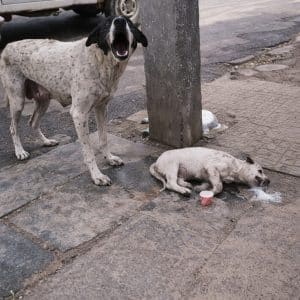
When Mishka was found, winter had nearly taken him.
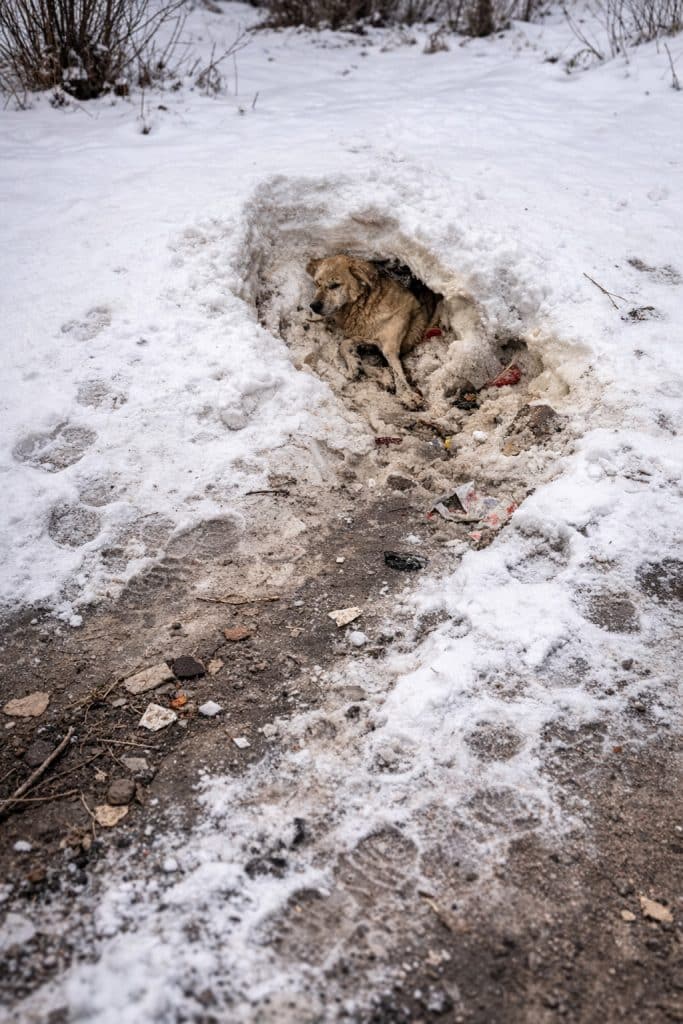
He had been trapped in a deep snow pit for three to four days. The cold had numbed his body. He was too weak to climb out. Too injured to run.
By the time rescuers reached him, he could not stand.
His body trembled from exhaustion and exposure. Every movement seemed to bring visible discomfort. Yet his eyes remained open, alert — as if he was still waiting for help.
At the veterinary clinic, the X-rays revealed what no one expected.
Multiple pelvic fractures.
And something even more alarming.
His body contained embedded lead pellets, including one lodged dangerously close to his spine. The pain he must have endured was unimaginable — yet he had survived long enough to be found.
Choosing Caution Over Risk
The medical team faced a difficult decision.
Surgical repair of the pelvis carried significant risk. His condition was fragile. The trauma extensive.
After careful discussion, they chose a different path.
Instead of immediate surgery, they focused on pain management around the clock. Gentle physical therapy began early to prevent muscle loss. Every movement was supervised. Every adjustment deliberate.
The prognosis was uncertain.
But Mishka remained steady.
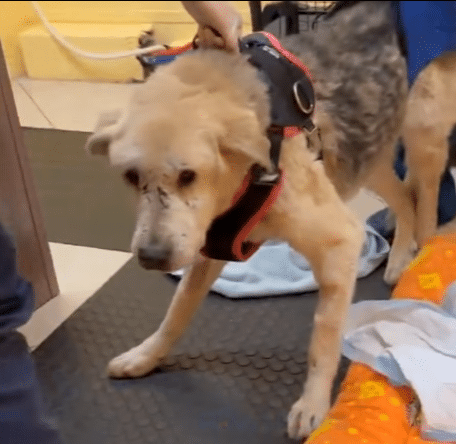
By day ten, he was introduced to a supportive wheelchair and lifting harness. With assistance, he began learning how to move again.
The first steps were not smooth.
But they were determined.
Video: Found Frozen and Unable to Stand — The Year-Long Recovery That Defied Every Expectation
Small Signs That Meant Everything
By day sixteen, something subtle shifted.
Mishka’s expression softened. He leaned into touch rather than away from it. He began accepting his new routine — therapy sessions, monitored walks, structured rest.
Then came an important milestone.
He regained control of basic bodily functions.
It may not sound dramatic.
But neurologically, it was profound.
It meant signals were returning.
It meant recovery was possible.
He was later transferred to the Yuna Veterinary Center for advanced rehabilitation. There, his training continued both indoors and outdoors — including exercises in snow and supported wheelchair walks across different surfaces.
Water, Patience, and Persistence
Around day forty, Mishka began hydrotherapy.
On an underwater treadmill, his legs moved against gentle resistance. The water reduced strain while strengthening weakened muscles. Each session required effort.
Each session required trust.
By day seventy-two, his balance improved.
By day one hundred ten, he achieved something that once seemed unlikely.
He walked on grass using his own legs.
Slowly.
Carefully.
But independently.
Supervision was still necessary, and strength was still building. Yet the dog who once could not rise from the snow was now stepping forward under open sky.
A Year Later — Running Through Snow Again
Time continued.
By day one hundred thirty, Mishka’s transformation was visible not only in movement but in spirit. He was alert, playful, engaged.
He joined other dogs in supervised play. He explored outdoor spaces. He responded warmly to caregivers.
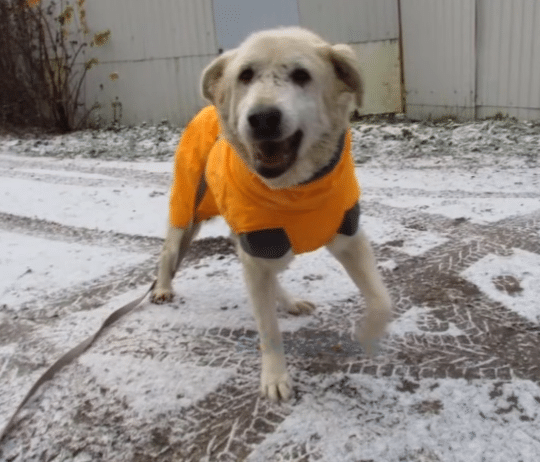
By day three hundred sixty, nearly a full year after rescue, Mishka had become nearly unrecognizable from the fragile dog found frozen in place.
He ran across snow once more.
Not trapped within it.
But gliding over it.
His foster family provided stability, warmth, and ongoing care. The embedded pellets remained part of his story, but they no longer defined his present.
What Mishka’s Journey Teaches Us
Recovery is rarely immediate.
Sometimes it unfolds over months.
Sometimes over a year.
Mishka’s story is not about dramatic surgery.
It is about persistence.
It is about choosing rehabilitation when outcomes are uncertain.
It is about showing up every single day — even when progress is measured in millimeters.
The dog who once lay helpless in snow now moves with confidence.
Not because the road was easy.
But because someone refused to give up.
And sometimes, that refusal — steady, patient, compassionate — is what creates what feels like a miracle.