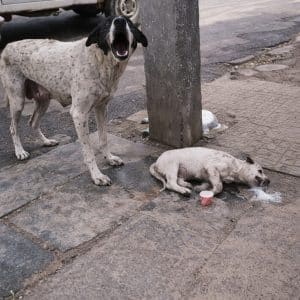
A Dog Chained in the Corner
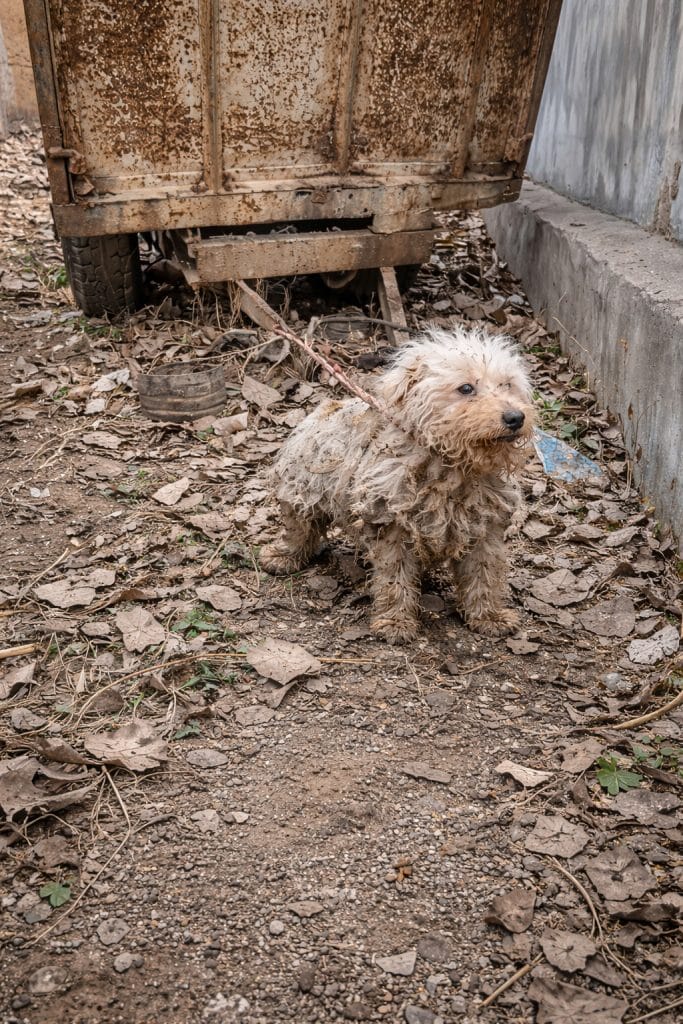
When A Phong and Dai Shu received the call, they were told only that a Greyhound had been injured.
What they found was far worse.
In a dirty corner of a concrete yard, a thin hunting dog — once valued for speed and strength — was chained tightly against a stained wall. His ribs showed sharply beneath fragile skin. His body trembled uncontrollably, even before anyone touched him.
His front leg hung at an unnatural angle.
He did not bark.
He did not struggle.
He simply shook.
The owner explained with indifference that the dog had chased and killed a neighbor’s chicken. Compensation had to be paid. In anger, punishment followed.
The leg was broken during that outburst.
Now, seeing no future use for the injured Greyhound, the owner announced he would sell him for meat — 1,500 yuan.
The rescuers stood firm.
They were not negotiating value.
They were negotiating time.
After tense back-and-forth discussion, they secured the dog for 850 yuan.
Money exchanged hands.
But what truly changed was his fate.
The Trembling That Wouldn’t Stop
At the veterinary hospital, the Greyhound — later gently called Linh Mieu — continued shaking even in a quiet examination room.
Every movement near him triggered fear.
The diagnosis confirmed what his posture had already suggested.
A severe fracture at the front leg joint.
An old wound, already infected.
Pus and blood trapped beneath swollen tissue.
Because of the infection and tissue damage, immediate surgery was too risky. First, inflammation had to be controlled. The wound required careful cleaning and draining. Antibiotics were started immediately.
The doctors also needed to assess nerve function — whether the leg could regain strength or whether permanent damage had already occurred.
Through it all, Linh Mieu stayed silent.
His body endured.
His eyes remained distant.
Video: They Were About to Sell Him — Until Two Strangers Refused to Walk Away
Healing a Body That Had Known Only Force
The first stage of treatment focused on stabilization.
Daily wound care.
Careful flushing of infected tissue.
Anti-inflammatory medication.
Monitoring of circulation and nerve response.
Each procedure was done slowly.
Not only because of medical caution — but because Linh Mieu startled easily. Even gentle touch caused him to recoil.
Trust had been broken long before his leg was.
But the rescuers did not rush him.
They sat beside his kennel.
Spoke softly.
Allowed him to observe without pressure.
Recovery would not come from medicine alone.
Another Life Hidden Beneath a Car
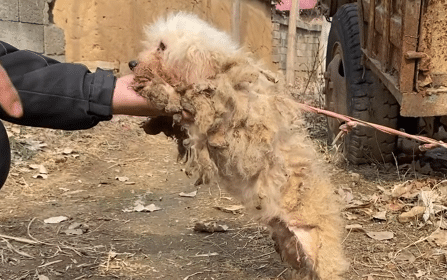
At nearly the same time, the team responded to another call.
Underneath an old, abandoned vehicle, tucked into shadow, was a small white curly-haired dog. His fur was heavily matted and dirty, clumped from long neglect.
He avoided eye contact.
He flinched at movement.
But he did not show aggression.
A neighbor explained quietly that the dog’s former owner had once loved animals deeply. But after suffering severe mental health struggles, something changed. Care turned into neglect. Neglect into mistreatment.
The small dog had survived by hiding.
He was lifted gently and brought to the same rescue center — the “Little Courtyard” where fragile cases found temporary refuge.
Two different stories.
One shared outcome.
The First Baths, The First Calm Moments
Back at the rescue center, both dogs began the slow work of renewal.
The small white dog was bathed carefully. Layers of dirt and tangled fur were trimmed away. Underneath the matting was sensitive but healthy skin. Once cleaned, his true shape emerged — delicate, but intact.
Linh Mieu continued medical care. Swelling gradually decreased. Infection began responding to antibiotics. There was cautious hope that surgical repair might become possible once tissue stabilized.
But something equally important began happening in parallel.
They started watching the people around them without flinching.
They accepted food directly from hands.
They rested more deeply at night.
Fear loosened its grip — slightly, but meaningfully.
More Than Physical Recovery
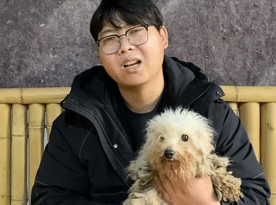
Linh Mieu’s leg still faced a long road ahead. Physical therapy would be required. Strength would not return overnight. But the trembling slowly decreased.
The small white dog, once hidden under a car, began stepping into open spaces within the yard.
They were not fully healed.
But they were no longer alone.
What Their Stories Ask of Us
Animals do not calculate worth the way humans sometimes do.
They do not measure value in money.
They do not understand being discarded.
They respond to care.
They respond to tone.
They respond to consistency.
These two dogs were nearly reduced to problems to be solved — one as a financial burden, the other as an unintended casualty of human instability.
Instead, they were given something simple but powerful:
Time.
Medical care.
Gentleness.
Rescue does not erase cruelty.
But it interrupts it.
It says that even when circumstances are complicated, even when mistakes are made, life still deserves protection.
Linh Mieu and the small white dog now rest in a place where chains and hiding are no longer necessary.
Their future remains unwritten.
But it is no longer for sale.